
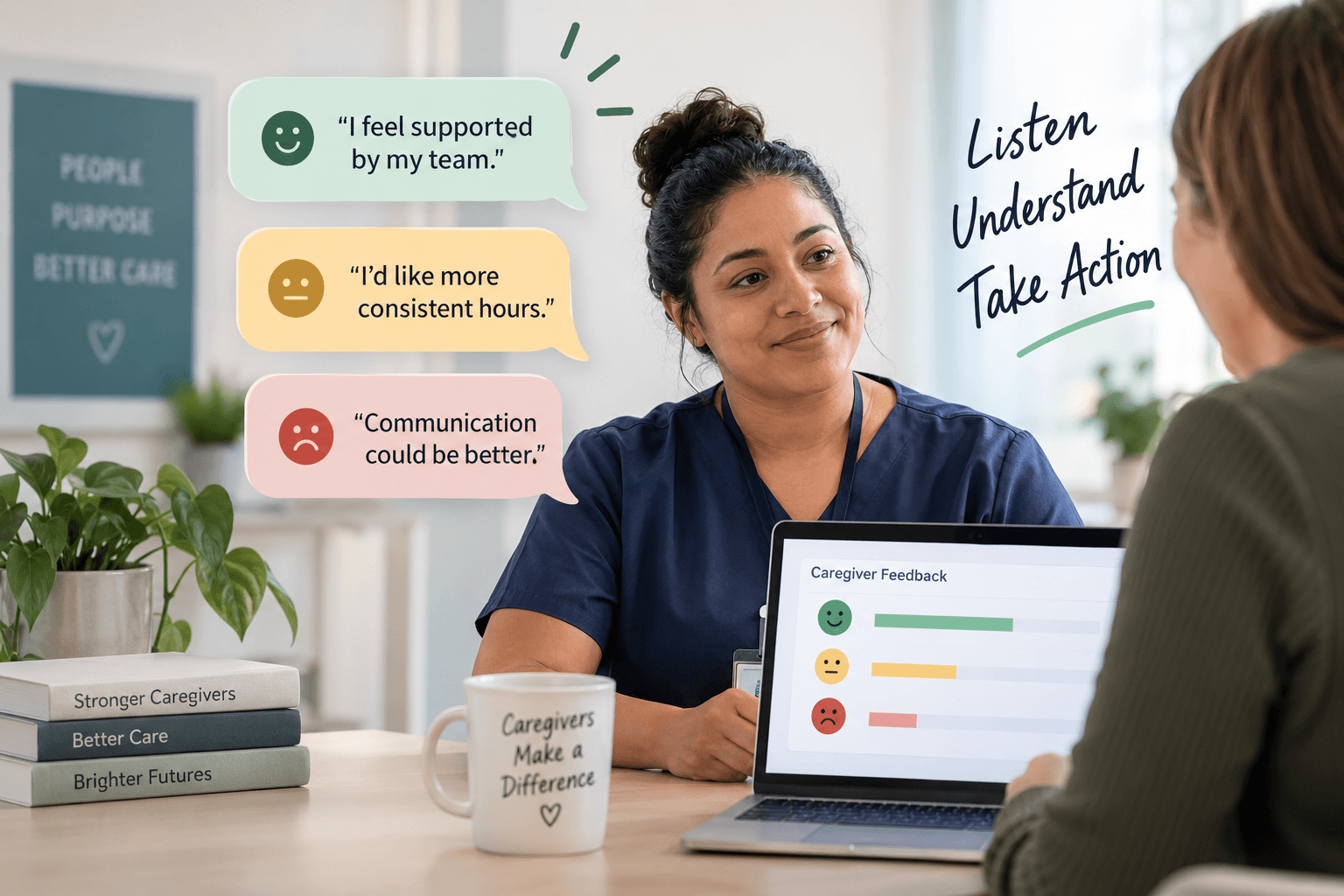
Asking caregivers for feedback is easy.
Getting honest feedback is harder.
A caregiver may be frustrated with scheduling, struggling with a client assignment, or feeling unsupported by the office. But when someone asks, "How's everything going?" the answer may still be:
"Fine."
That can create a dangerous gap for in-home care agencies.
Leadership believes everything is going well. The caregiver quietly becomes more frustrated. Then one day, they turn in their notice.
The resignation may feel sudden, but the problem may have been building for weeks or months.
Regular caregiver feedback can help close that gap. But only if caregivers feel comfortable telling you what is really happening.
Caregiver recruitment and retention continue to be major challenges for in-home care providers.
In HHAeXchange's 2026 Homecare Insights Provider Survey, 54% of responding providers identified caregiver recruitment as a top workforce challenge. Agencies also reported focusing on flexible scheduling, support and recognition, training, and workload as ways to improve recruitment and retention.
That makes caregiver feedback more than an employee engagement exercise.
It can help agency leaders understand whether the things they are doing to support caregivers are actually working.
Feedback can uncover problems involving:
The earlier those problems are identified, the more opportunity an agency has to respond.
A caregiver can be unhappy without ever making a formal complaint.
They may worry that speaking up will affect their hours.
They may not want to be seen as difficult.
They may assume nothing will change.
They may have raised concerns before and felt ignored.
Or they may simply believe leaving is easier than having an uncomfortable conversation.
That is why agencies cannot rely entirely on caregivers volunteering information.
If the only way leadership learns about a problem is when an employee walks into the office and complains, many problems will remain hidden.
Instead, agencies need to create regular opportunities for caregivers to share what they are experiencing.
Do not wait until a caregiver appears unhappy.
Make feedback a normal part of working for your agency.
That could mean checking in:
This changes the conversation.
Instead of feedback feeling like something that only happens when there is a problem, it becomes part of the caregiver experience.
That can make it easier for caregivers to speak honestly when something eventually does go wrong.
If you are building a formal feedback process, our guide to Caregiver Satisfaction Surveys: 12 Questions In-Home Care Agencies Should Ask provides questions you can use to get started.
You do not need a 30-question employee survey every month.
In fact, long surveys may work against you if caregivers stop completing them.
Regular feedback can be much simpler.
For example:
How satisfied are you with your current schedule?
How supported do you feel by the office?
How satisfied are you with your current client assignment?
Is there anything making your job more difficult right now?
That may be enough to identify a caregiver who needs additional attention.
A longer survey can still be useful occasionally.
But frequent feedback should be easy to provide.
"How are things going?" is a difficult question to answer honestly.
It is too broad.
A caregiver may say everything is fine even if one part of the job is creating serious frustration.
Specific questions make it easier to identify the issue.
Instead of:
Are you happy working here?
Try:
How satisfied are you with your schedule this week?
Instead of:
Is everything going okay with your client?
Try:
Do you feel this client assignment is a good fit for you?
Instead of:
Do you need anything?
Try:
Do you feel you have enough support from the office when a problem happens?
Specific questions produce information that is easier for leadership to act on.
Not every caregiver will feel comfortable providing feedback the same way.
Some people prefer talking directly to a supervisor.
Others may be much more honest in a written survey.
And some concerns may only come out if feedback can be anonymous.
Consider providing several options, such as regular caregiver surveys, one-on-one check-ins, text-based feedback, anonymous feedback, supervisor conversations, and post-assignment check-ins.
The goal is not to create a complicated feedback program.
It is to remove unnecessary barriers between caregivers and leadership.
If someone has something important to say, there should be an easy way to say it.
This may be the most important part.
Caregivers need to believe that giving honest feedback will not hurt them.
Imagine an agency sends a survey asking caregivers to be completely honest.
A caregiver responds that the scheduler is difficult to work with.
The scheduler then confronts the caregiver about their response.
What happens the next time that caregiver receives a survey?
They probably will not be as honest.
The same lesson may spread to other employees.
Agencies should be clear about how caregiver feedback will be used and who will see it.
Leaders also need to respond professionally when the feedback is uncomfortable.
You do not have to agree with every complaint.
But caregivers should be able to raise a concern without feeling punished for raising it.
Suppose one caregiver consistently rates their job satisfaction a 6 out of 10.
Another caregiver normally rates it a 9 but suddenly reports a 6.
Those scores are identical.
But they may not mean the same thing.
The second caregiver has experienced a meaningful change.
Maybe their schedule changed.
Maybe they were assigned to a new client.
Maybe communication with the office became frustrating.
Maybe something happened that leadership does not know about.
That is why caregiver feedback becomes more useful when it is tracked over time.
A change in sentiment can become an early warning signal.
Our guide to Why Caregivers Leave: 9 Warning Signs In-Home Care Agencies Should Watch covers other changes agencies should watch for.
Ratings are useful because they are easy to measure.
But numbers do not always explain the problem.
A caregiver may rate their schedule a 5 out of 10.
Why?
Maybe they need more hours.
Maybe they have too many hours.
Maybe their first shift starts too early.
Maybe they are driving too far between clients.
Maybe schedules are changing without enough notice.
You will not know from the score alone.
That is why every caregiver feedback process should include an opportunity to explain.
Questions like these can help:
What is the biggest challenge you are experiencing right now?
What could we do to make your job easier?
Is there anything you wish the office understood about your experience?
What is one thing you would change about working here?
The answers may reveal problems leadership did not know existed.
Not all feedback requires an immediate response.
Some of it is simply information to track over time.
Other feedback should create action.
If a caregiver reports a safety concern, a serious client problem, harassment, or another urgent issue, it should not sit unnoticed inside a monthly report.
Agencies need a way to identify feedback that requires follow-up.
Even less urgent concerns can benefit from a quick response.
For example, a caregiver says they are unhappy with an assignment.
Someone from the office follows up the next day.
Even if the assignment cannot be changed immediately, the caregiver now knows someone heard them.
That matters.
One of the fastest ways to make employees stop giving feedback is to ask for it repeatedly and never show that anything changes.
Caregivers do not need every suggestion approved.
But they should know their feedback goes somewhere.
Suppose multiple caregivers say last-minute scheduling changes are creating frustration.
Leadership changes part of the scheduling process.
Tell caregivers.
You might say:
"Several caregivers told us that last-minute schedule changes were causing problems, so we are changing how we communicate open shifts."
That demonstrates that feedback can produce action.
It also makes caregivers more likely to participate the next time you ask.
Individual feedback can help solve individual problems.
Combined feedback can help solve business problems.
Imagine that several caregivers say:
Those are no longer isolated complaints.
They are operational signals.
The home care industry is also putting more attention on using workforce data to guide decisions. In the 2026 Homecare Insights Provider Survey, 42.2% of agencies said they were not currently using data from reporting tools to guide business decisions, while 27.8% identified reporting and insights as an area for investment.
Caregiver feedback can become another valuable source of that information.
There is another trap agencies should avoid.
The employees most willing to talk with leadership may be the employees who already feel engaged.
That can create an incomplete picture.
The caregiver who regularly stops by the office may tell you exactly how they feel.
The caregiver who is slowly disengaging may say nothing.
That is why a consistent feedback process matters.
You want to hear from caregivers who are happy, caregivers who are frustrated, new employees, experienced employees, and people working different schedules and client assignments.
Otherwise, leadership may only hear from the people who are easiest to hear.
Caregivers see parts of the client experience that office staff cannot.
Clients and families see parts of the caregiver experience that the caregiver may never mention.
That makes the two sources of feedback especially valuable together.
For example, a caregiver may report that a client assignment is becoming difficult.
At the same time, the client may report declining satisfaction.
Together, those signals tell leadership much more than either one by itself.
Agencies can use our guide to measuring home care client satisfaction to build the client side of that feedback process.
Both can also play a role in client retention and the overall reputation of a caregiving business.
Do not panic.
Negative feedback is not necessarily bad news.
A caregiver who tells you they are frustrated has given you information.
The more dangerous situation may be the caregiver who is equally frustrated but never says anything.
When negative feedback comes in, start by understanding the issue rather than immediately assuming you know what caused it.
Then determine whether it is an individual problem or part of a larger pattern.
One poor client match is different from 20 caregivers complaining about assignments.
Follow up when appropriate. Track whether the issue continues. And when you make a change because of caregiver feedback, tell employees what changed.
Not every complaint requires a new policy.
But every meaningful pattern deserves to be understood.
Caregiver turnover can look sudden from the agency's point of view.
It may not feel sudden to the caregiver.
They may have been frustrated with their schedule for two months.
They may have felt ignored after raising a concern.
They may have slowly started accepting fewer shifts.
They may have already begun looking for another job.
Regular caregiver feedback gives leadership a chance to see part of that process before the resignation arrives.
That does not mean every caregiver will stay.
But it gives the agency something it would not otherwise have:
Time to respond.
Caregivers should not need an exit interview to tell an agency what went wrong.
The best feedback programs make listening part of the normal employee experience.
Ask regularly.
Make it easy.
Ask specific questions.
Give caregivers a safe way to be honest.
Look for changes in sentiment.
Respond when something needs attention.
And show people that their feedback matters.
Saint helps caregiving businesses collect caregiver sentiment, identify patterns, and give leadership better visibility into what caregivers are experiencing.
Instead of learning what went wrong after a good caregiver leaves, agencies can start listening while there is still an opportunity to act.
Schedule a demo to see how Saint can help your agency collect caregiver feedback and spot retention risks earlier.
Grow your business online fast!
It includes strategies on:
Where to get reviews
Evaluating your online presence
Setting a review goal for your business
Avoiding bad reviews
Maximizing positive reviews