
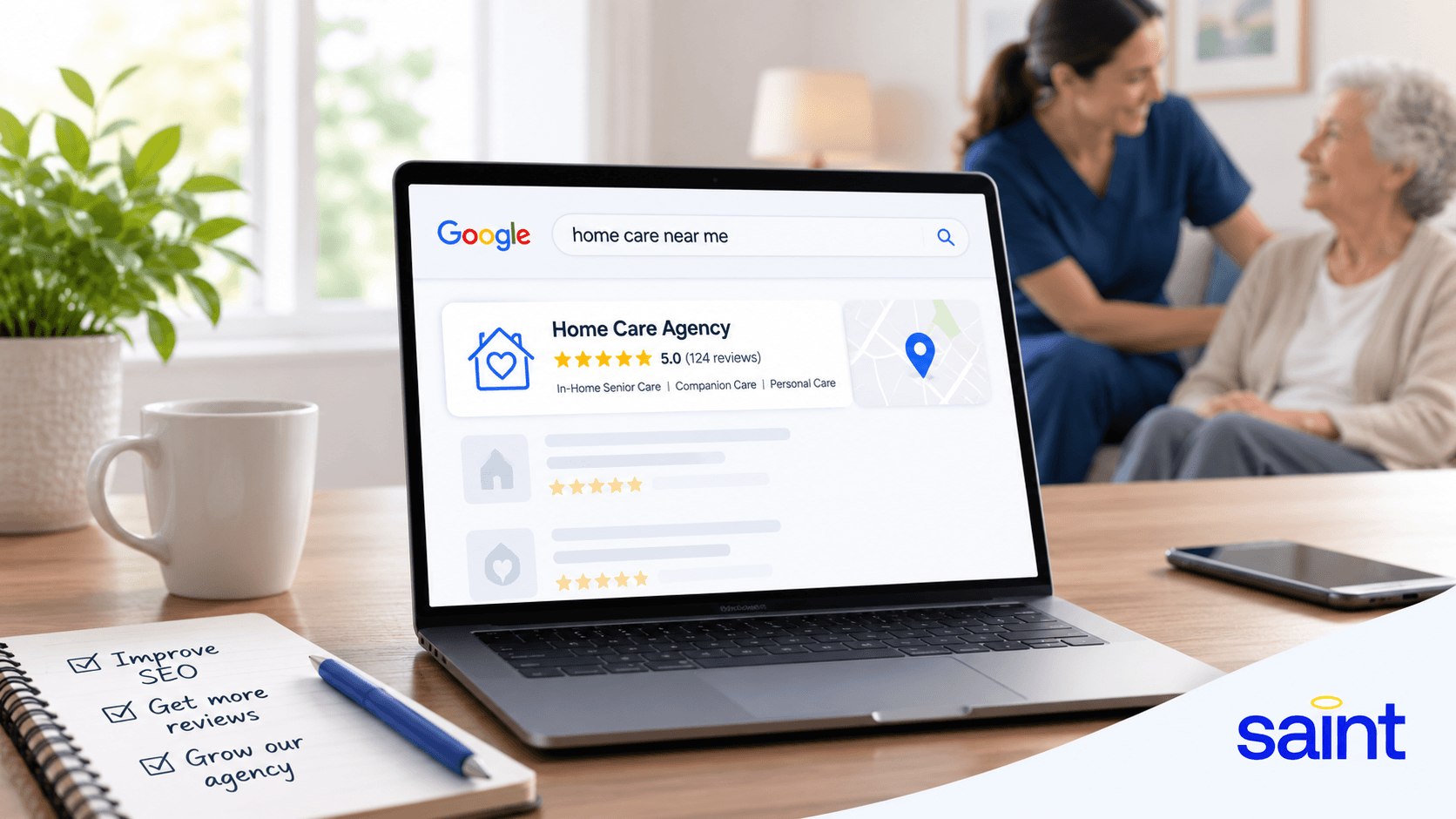
When a family needs home care, one of the first places they often turn is Google.
They may search for "home care near me," "dementia care in [City]," or "private pay home care." They compare agencies, read reviews, visit websites, and decide which providers seem trustworthy enough to call.
If your agency doesn't appear in those searches, you're missing opportunities to connect with families who are actively looking for care.
That's where home care SEO comes in.
Search engine optimization, or SEO, helps your agency become more visible when people search online for the services you provide. Unlike paid advertising, you don't pay Google every time someone visits your website from an organic search result.
But successful SEO requires more than adding a few keywords to your website.
Home care agencies need strong service pages, local relevance, helpful content, Google reviews, a well-optimized Google Business Profile, quality links, and a website Google can easily understand.
This guide walks through how to build that strategy.
Home care SEO is the process of improving your website and online presence so your agency can appear more prominently when people search for home care services.
For example, imagine your agency provides companion care, personal care, respite care, and dementia care in Annapolis and surrounding communities.
Potential clients might search Google for:
SEO helps Google understand what your agency provides, where you provide it, and whether your website is a useful result for those searches.
The ultimate goal isn't simply more website traffic.
It's getting your agency in front of the right people at the right time.
Home care is an especially local and trust-driven service.
Families usually aren't looking for an agency across the country. They're looking for a provider that serves their community and can care for someone they love.
That makes Google an important part of the buying journey.
A family might first discover your agency in Google Maps, read your reviews, visit a service page, read an article answering one of their questions, and return several days later to schedule a consultation.
SEO helps your agency appear throughout that process.
A strong home care SEO strategy can help you:
SEO and paid advertising can work together, but they operate differently.
Google Ads can provide visibility quickly while you're paying for campaigns. SEO generally takes longer to build, but a page that earns strong organic rankings can continue bringing visitors to your website without paying for every individual click.
You don't need to understand every part of Google's algorithm to improve your home care SEO.
It helps, however, to understand what Google is trying to accomplish.
When someone searches for home care, Google wants to provide useful and relevant results.
For a home care agency, that means several things can matter.
Does your website actually provide what the person searched for?
If someone searches for "dementia home care," a detailed page about your dementia care services is likely more relevant than a generic homepage that briefly lists dementia care among ten other services.
Home care searches often have local intent.
If someone searches for "home care in Annapolis," Google needs to understand whether your agency actually serves Annapolis.
Your website, Google Business Profile, local business listings, service areas, and other online information can help establish that connection.
Google also tries to determine whether a page is useful and whether the website behind it appears credible.
Helpful original content, a strong website experience, relevant links from other websites, clear business information, and a well-established online presence can all contribute to that picture.
Your website also needs to work well.
A page that is extremely slow, difficult to use on a phone, confusing to navigate, or inaccessible to search engines creates problems for both visitors and Google.
The good news is that improving these areas often helps your marketing beyond SEO too.
One of the most common SEO mistakes is trying to rank for every possible phrase on every page.
A better strategy is understanding why someone is searching and creating the right page for that search.
Home care keywords generally fall into several useful categories.
These describe the care someone needs.
Examples include:
These searches are usually best targeted with dedicated service pages.
These combine a service with a geographic area.
Examples include:
These are especially valuable for local home care agencies because the searcher may already be looking for a provider.
These searches usually come from someone researching a problem or care decision.
Examples include:
Blog articles, guides, FAQs, and educational resources work well for these searches.
These indicate that someone may be getting closer to choosing a provider.
Examples include:
Your service pages, location pages, reviews, and overall website experience become especially important here.
For a deeper look at keyword research, see our guide to the best SEO keywords for home care agencies.
Finding keywords is only half the job.
You also need to decide which page should rank for each topic.
Suppose an agency offers dementia care in three communities.
It might organize its SEO strategy like this:
"Dementia home care" → Dementia Care service page
"Home care Annapolis" → Annapolis location page
"How much does dementia care cost?" → Educational article
"Home care near me" → Google Business Profile and locally relevant website pages
This prevents a common problem: creating several pages that all target essentially the same search.
When multiple pages cover nearly identical topics without providing distinct value, Google may have difficulty determining which one is the best result.
Give every important page a clear purpose.
For local home care searches, your Google Business Profile deserves significant attention.
It's the business listing that can appear in Google Search and Google Maps with information such as your:
Make sure the information is accurate and complete.
Don't add cities you don't actually serve or stuff keywords into your business name. Focus on providing useful, accurate information that reflects the real agency.
Your website and Google Business Profile should also tell a consistent story about what your agency does and where it operates.
We've created a complete walkthrough on how to optimize your Google Business Profile for your home care agency.
A single "Services" page is rarely the best way to explain everything your agency provides.
Your major services should generally have dedicated pages.
Depending on your agency, those might include:
But don't create thin pages simply because you want another keyword on your website.
A useful service page should help a family understand:
What is this service?
Who is it for?
What does care include?
How can it help my family?
Why should I trust this agency?
Where is the service available?
What should I do next?
That makes the page useful to both search engines and potential clients.
If you serve multiple communities, location pages can help you establish local relevance.
But there's an important distinction between useful location pages and simply changing the city name on the same page 20 times.
A good location page should contain information that's actually relevant to the community.
For example, a page about home care in Annapolis could discuss the services your agency provides there, neighborhoods or surrounding areas you serve, local contact information when applicable, and questions families in that market commonly ask.
Avoid creating dozens of nearly identical pages with only the city name changed.
The goal is to create a genuinely useful resource for someone looking for care in that area.
Your website is only one part of your local presence.
Google can encounter information about your agency across the web.
That may include:
Keep important business information consistent wherever possible.
Your local SEO strategy should also connect your website, reviews, Google Business Profile, and community presence.
We've broken this down further in Local SEO for Home Care Agencies: 12 Ways to Get More Local Clients.
If Google Maps visibility is your biggest concern, read How to Improve Your Home Care Agency's Google Maps Ranking.
Reviews serve two important purposes for home care agencies.
First, they help potential clients evaluate your agency.
Second, they strengthen your overall local presence on Google.
Think about the decision from the family's perspective.
If two agencies offer similar services in the same community, but one has a steady stream of detailed, recent reviews from clients and families, those reviews can make the agency easier to trust.
The key word is consistent.
Don't wait six months and suddenly ask 50 families for reviews.
Create a repeatable process for requesting feedback at natural points in the client relationship.
For example, you might request feedback after a successful first month of service, following a compliment about a caregiver, or after another positive care milestone.
If review generation is a challenge for your agency, start with How to Get More Google Reviews for Your Home Care Agency.
Blogging for SEO doesn't mean publishing random articles because someone told you Google likes fresh content.
Every article should have a purpose.
Start with the questions clients and families already ask your staff.
For example:
These topics can attract people earlier in their decision-making process.
More importantly, they demonstrate that your agency understands the questions families are trying to answer.
One strong, genuinely useful article is worth more than several thin articles written only to target keywords.
Internal links connect pages on your own website.
They help visitors discover related information and help search engines understand how your content fits together.
For example, an article discussing Google reviews might link to your detailed review-generation guide.
A home care marketing article might link to this SEO guide.
This SEO guide can then point readers toward more specific resources about:
Think of your website as a library rather than a collection of unrelated pages.
Your broad guides cover major topics. More specific articles explore individual parts of those topics. Internal links connect everything together.
Every important page should have a unique SEO title that clearly describes what the page contains.
Instead of:
Services | ABC Home Care
Consider something more descriptive, such as:
In-Home Companion Care in Annapolis | ABC Home Care
The exact title will depend on the page and keyword you're targeting.
Your meta description should also give searchers a reason to visit the page.
Meta descriptions aren't a place to cram in every keyword. Write a short description that accurately explains what someone will find after clicking.
Getting someone to your website isn't enough.
You also want them to stay, understand what you offer, and know what to do next.
Your website should:
Pay particular attention to mobile visitors.
Someone researching care for a parent may be searching from their phone while sitting in a hospital waiting room, talking with siblings, or handling dozens of other responsibilities.
Make it easy for them.
For more ideas, see 15 Things Every Home Care Website Needs to Convert More Visitors Into Clients.
You can create the best home care content in your market, but it won't generate organic traffic if Google can't properly discover or index it.
Start by setting up Google Search Console.
Search Console can help you see:
You should also have an XML sitemap that contains the pages you want search engines to discover.
When you publish an important new page, make sure it is internally linked from somewhere else on your website. Don't leave valuable content isolated where visitors and search engines have difficulty finding it.
And remember: submitting a page to Google does not guarantee that Google will index it.
Google still decides whether a page provides enough value to include in its search index.
That's another reason quality and uniqueness matter.
A backlink is a link from another website to yours.
Links can help search engines discover your website and understand its authority, but quality matters much more than simply collecting as many links as possible.
For a local home care agency, useful backlink opportunities might come from:
Think locally.
If your agency sponsors a community event, partners with a local organization, contributes expertise to a local publication, or joins a legitimate business association, there may be a natural opportunity for that organization to link to your website.
Avoid buying large packages of low-quality backlinks or chasing unrelated websites simply because they offer a link.
A handful of relevant, credible links can be much more valuable than hundreds of questionable ones.
SEO isn't something you should run on instinct alone.
Google Search Console and your website analytics can show you what's happening.
Don't look only at clicks.
For a growing website, impressions can provide valuable early information.
Suppose Google begins showing one of your pages for:
"dementia home care Annapolis"
The page might receive only a handful of impressions initially.
But that's useful information.
Google is beginning to associate your page with that search.
You can then review the page and ask:
Search data can help determine what you improve next.
Over time, track:
Traffic is useful.
Qualified leads are better.
SEO can feel overwhelming because there are so many things you could improve.
Instead of trying to fix everything at once, break the work into three stages.
Start with your existing website.
Focus on:
Don't rush into publishing dozens of articles before your foundation is ready.
Next, make sure you have strong pages for the searches most likely to produce clients.
That can include:
Assign a clear search purpose to each page.
You don't need a separate page for every keyword variation.
You need the best possible page for each important topic.
Once your foundation and core pages are stronger, begin expanding your authority.
Focus on:
At the end of 90 days, review what Google is telling you.
Which pages are gaining visibility?
Which queries are appearing?
Which pages aren't being indexed?
Which topics are producing leads?
Use that information to plan your next 90 days.
SEO isn't only about knowing what to do.
Knowing what not to do can save you a lot of time.
Don't create 30 pages with essentially identical text and replace only the city name.
If a location deserves its own page, make that page useful to someone searching for care in that community.
More pages don't automatically mean more rankings.
If five pages all try to rank for "home care Annapolis," you may create unnecessary competition within your own website.
Give each page a clear purpose.
You don't need an article every day.
You need useful content that answers real questions.
Write for people first.
You don't need to repeat "home care agency Annapolis Maryland" in every paragraph for Google to understand your topic.
SEO isn't only about publishing something new.
Sometimes improving an existing page is the best opportunity.
If Google is already showing a page in search results but very few people are clicking it, improve the title and description.
If a page is getting impressions but ranking poorly, strengthen the content and internal links.
If several articles cover almost the same topic, consider whether they should be consolidated.
SEO can get someone to your Google profile or website.
Your reputation helps determine what happens next.
Strong visibility with weak reviews may still result in lost opportunities.
Ranking #1 sounds great.
But ranking #1 for a phrase nobody searches or a query that never produces clients isn't particularly valuable.
The real goal is business growth.
There is no universal SEO timeline.
A new agency website in a competitive metropolitan area faces a very different challenge than an established website in a smaller market.
Your results can depend on factors such as:
Think of SEO as building an asset rather than launching a short-term campaign.
Early progress may show up as Google indexing more pages and increasing impressions.
Then some pages may begin moving higher in search results and earning clicks.
Eventually, the metric that matters most is whether organic search is producing qualified inquiries.
You don't necessarily need an SEO agency to improve your search visibility.
There is plenty a home care owner or marketing employee can do internally.
Start with the fundamentals:
More advanced technical problems or highly competitive markets may eventually require specialized help.
But don't let that prevent you from starting.
A consistent, well-organized strategy can accomplish much more than publishing random articles and hoping something ranks.
SEO gets your agency discovered.
Your reputation helps turn that visibility into trust.
Imagine someone searches for home care in your city and sees your agency in Google Maps.
What happens next?
They may immediately look at:
Your star rating.
How many reviews you have.
How recent those reviews are.
What families say about your caregivers.
How your agency responds to feedback.
That's why review generation and reputation management should work alongside your SEO strategy.
Saint helps home care agencies automate review requests, identify negative feedback earlier, and track the client and caregiver experiences shaping their reputation.
Instead of treating reviews as something you occasionally remember to ask for, you can build a more consistent process for earning feedback and strengthening trust.
Learn more about Saint's reputation and retention tools.
Home care SEO is the process of improving a home care agency's website and online presence so it can appear more prominently when people search Google for home care services, information, or providers.
SEO can be an effective way for home care agencies to reach families who are already researching care. Results depend on factors such as competition, location, website quality, content, authority, and how consistently the agency works on its search presence.
The best keywords depend on the agency's services and locations. Valuable searches can include service terms such as "dementia home care," local searches such as "home care in Annapolis," and informational searches such as "how much does home care cost?"
Yes. Because most home care agencies serve defined geographic areas, local search visibility can be especially valuable. Your Google Business Profile, website, reviews, local content, business listings, and community presence can all contribute to your local SEO strategy.
It can. Useful articles allow your website to answer questions potential clients are searching for and can strengthen your coverage of important topics. Publishing low-quality articles simply to add more pages is unlikely to provide the same value.
There isn't a perfect number. Focus on consistency and quality rather than hitting an arbitrary publishing schedule. One excellent resource that answers an important question can be more valuable than several thin articles.
Yes, particularly when the agency genuinely serves those locations. Dedicated location pages can help, but each page should provide useful information rather than duplicating the same content with different city names.
SEO focuses on earning visibility in organic search results, while Google Ads allows agencies to pay for placement in sponsored search results. Ads can provide visibility quickly, while SEO is generally a longer-term strategy. Many agencies use both.
Home care SEO isn't about finding a secret trick that puts your agency at the top of Google overnight.
It's about making your website genuinely useful to the families you're trying to reach.
Build strong service pages. Make your locations clear. Optimize your Google Business Profile. Earn reviews. Answer the questions families are asking. Build local authority. Monitor what Google is telling you. Then keep improving.
Over time, those individual efforts start working together.
And when a family in your community turns to Google looking for help, your agency has a better chance of being there when they need it.
Grow your business online fast!
It includes strategies on:
Where to get reviews
Evaluating your online presence
Setting a review goal for your business
Avoiding bad reviews
Maximizing positive reviews